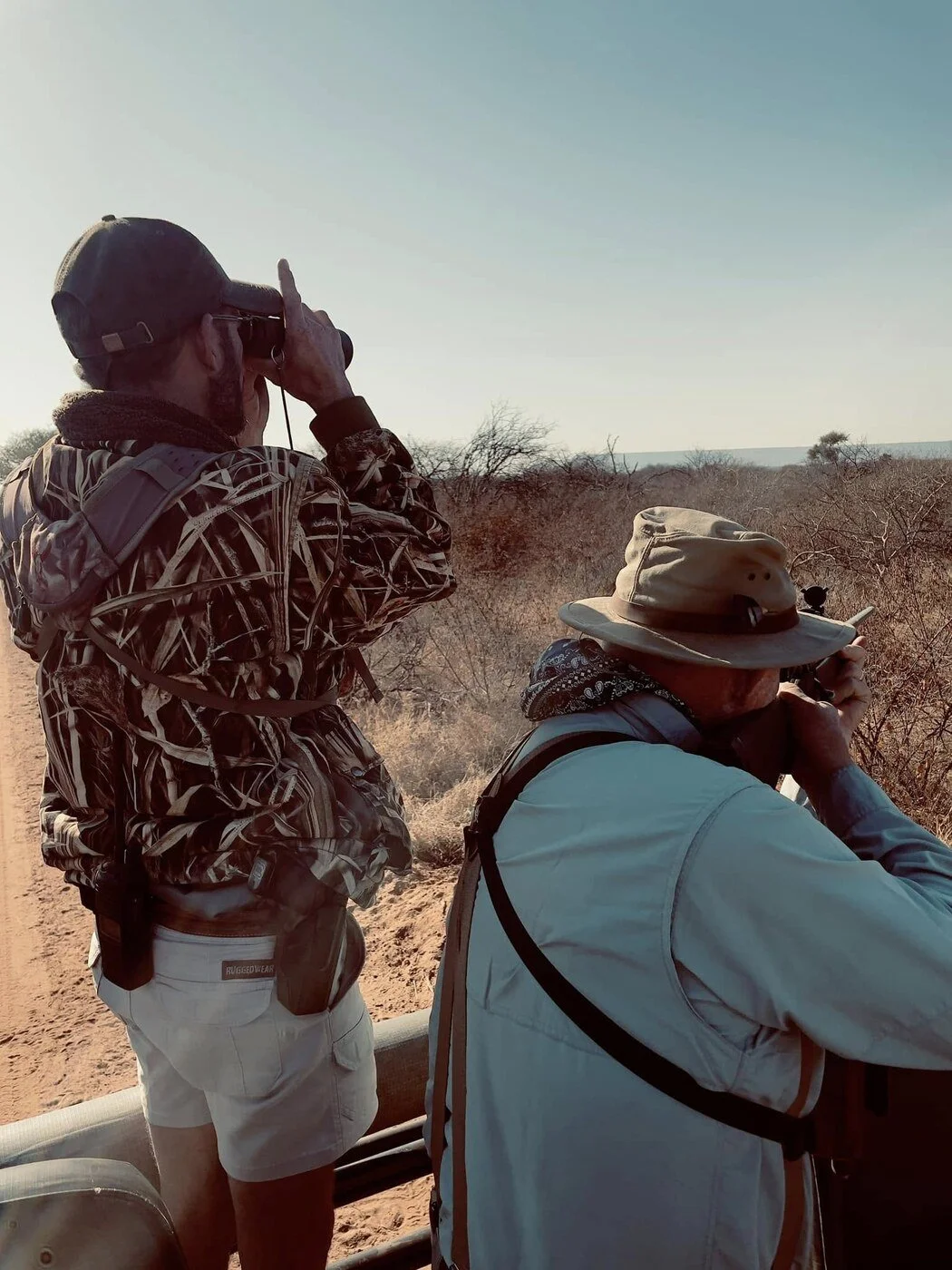
There is an old saying that a professional hunter can tell what kind of client he has before the first shot is ever fired.
I believe that now.
On my third trip to Africa, I took my dad with me. We were headed to South Africa’s Limpopo Province to hunt with Kuvhima Safaris.
Neither of us was new to Africa. Those first excursions had come courtesy of Uncle Sam and involved a very different kind of safari.
After arriving in Johannesburg, we spent a couple of days getting settled before Uncle Piet arrived to drive us north. Piet deserves a chapter of his own someday. He was one of those rare men who quietly became part of every hunt.
Rest easy, my friend.
Pulling into camp was my first surprise.
Instead of the postcard image of an African hunting lodge, we rolled into something that looked more like a small military compound. Barbed wire. Outward-facing lights. Gates.
For Dad and me, it felt strangely familiar. We had spent enough years around places like that to settle in almost immediately.
The staff greeted us with cold orange juice. It was August, and the African afternoon still carried plenty of heat. We met everyone who would be taking care of us over the next ten days before a man stepped forward with an easy smile.
“Burt.”
He wasn’t physically imposing. About five-foot-nine, lean as a whip, wearing faded khaki shorts, Courtney vellies, a worn Kuvhima Safaris shirt, a tired John Deere ball cap, and a Glock that looked as though it had spent more time outdoors than in a safe.
Everything about him suggested one thing: this man walked. Every day. For miles. Behind buffalo, kudu, and whatever else Africa decided to offer. Every movement was deliberate and economical.
After the introductions, he smiled.
“Well, gentlemen… shall we go see if your rifles are shooting at ducks or lions, eh?”
Dad and I climbed into the extended-cab Land Cruiser, and Burt headed down the dusty red road toward the range.
There wasn’t much to it. A couple of berms, target stands, and a sturdy shooting bench.
“You two just wait here while I put the targets up.”
We wandered over to the bench and simply took it all in.
The African evening.
The birds.
The smell of dust settling after the Cruiser had stopped.
The sounds coming from the brush.
We were finally back in Africa.
Sharing that moment with my dad remains one of my favorite memories.
When Burt returned, I could almost see the wheels turning.
Who are these two?
He looked us over.
Our safari hats weren’t fresh from the outfitter’s shelf. They were sweat-stained, sunscreen-stained, bug-dope-stained, and carried enough miles to tell their own stories.
“First time in Africa?”
“No,” Dad answered. “Just the first time hunting.”
Burt grinned.
Dad unzipped his rifle case and pulled out an old Ruger M77. Once green, the synthetic stock had become its own camouflage pattern from years of scratches earned in Alaska. The bluing was worn. The muzzle carried the polished look of a rifle that had actually been fired. The scope had white edges where countless bush planes, boats, and trucks had rubbed away the finish.
Burt didn’t say much.
He simply looked.
Really looked.
Dad cycled the action, laid out three 225-grain cartridges, then paused.
“What are you waiting for?” Burt asked.
Dad shrugged.
“Well… you’re the range master. It’s your range.”
Burt’s smile grew just a little wider.
Dad fed the first round into the chamber, settled behind the rifle, and waited for the signal.
Boom.
The first round landed about an inch high.
Boom.
The second touched the first.
Burt raised his hand.
“Cease fire.”
He looked at Dad.
“You’re shooting high.”
Dad answered without hesitation.
“At two hundred, it’ll drop about an inch. It’ll be dead on there.”
Burt simply nodded.
He wasn’t asking because he thought something was wrong.
He wanted to know if Dad knew his rifle.
He did.
Then Burt turned toward me.
“Your turn.”
I opened my old canvas rifle case and lifted out my Ruger No. 1, chambered in 9.3×74R and topped with a little Nikon Monarch 1–4×.
His eyebrows climbed.
He studied the rifle from every angle, like a craftsman examining another man’s work.
“What caliber?”
“Nine-point-three by seventy-four R.”
“What are you shooting?”
“Two-hundred-and-eighty-six-grain softs and three-hundred-grain solids.”
He smiled.
“You don’t see that caliber enough anymore. Everybody wants to bring a .300 Winchester, a .375, or whatever the newest thing is.”
He looked at the rifle once more.
“You brought a classic.”
I checked the chamber, settled behind the bench, found my breathing, and began taking the slack out of the trigger.
The Ruger No. 1 has one of those triggers that rewards patience.
Boom.
The rifle barked.
A heartbeat later came the unmistakable thwack of a heavy bullet striking the backstop.
The dust settled.
Before I could even lift my head, Burt spoke.
“Well…”
“I think we’re done here for today.”
I looked at him.
“Are you sure? We haven’t even checked the target.”
“If you want to shoot another one, go ahead.”
Challenge accepted.
Another soft point slid into the chamber.
Another careful squeeze.
Boom.
Thwack.
This time, I picked up my binoculars.
The second bullet had passed through the first hole, simply enlarging it.
Burt laughed.
“See?”
“I’m satisfied.”
Back at the lodge that evening, another PH, Jannes, noticed Burt wearing a grin that refused to disappear.
“What’s got you smiling?”
Burt nodded toward Dad and me.
“These two are going to be a pleasure to hunt.”
“How do you know?”
Burt leaned back.
“When they pulled their rifles out, I could already tell they were working rifles.”
“They’ve been hunted.”
“When Scott unpacked that Ruger No. 1…”
He smiled again.
“I knew I was going to like these fellows.”
“And after four rounds downrange…”
He shrugged.
“I wasn’t worried about a thing.”
Later in the hunt, Burt explained something that has stayed with me ever since.
He said many hunters arrive carrying expensive rifles they have barely used. They’re afraid of scratches. They complain about the weight. Someone else carries their gear. They expect Africa to be something provided for them.
Then he looked at Dad and me.
“You two showed up with working rifles.”
“You carried your own gear.”
“You looked after your own equipment.”
“You’re up before daylight with coffee.”
“You thank the camp staff.”
“You know your rifles.”
It wasn’t really a compliment about our shooting.
It was a compliment about how we approached hunting.
Looking back now, I don’t think the range session was ever about confirming zero.
It was about something much older.
Two experienced hunters quietly measuring one another.
The targets merely confirmed what Burt had already suspected.
Long before the first shot was fired, he had decided that Dad and I hadn’t come to Africa to play hunter.
We had simply come to hunt.
