By Scott Miller · Forbes-Miller Expeditions
We had two totes of Mountain House meals, several ways to boil water, and enough outdoor equipment to suggest that none of us should be allowed into a sporting-goods store without supervision.
Dad, Charlie, and I were in Charlie’s garage, sorting through decades of gear. There was the tried-and-true equipment, the newer equipment, and the equipment purchased during some brief but persuasive period when we believed a particular gadget would improve our lives.
Time had not been equally kind to all three categories.
The purpose was to take stock, sort things out, and consider what we needed for the trips ahead. We were also drinking hot coffee and telling stories, which did little for the efficiency of the inventory but considerably improved the undertaking.
This is the part that rarely makes it into an expedition photograph. Nobody frames a picture of three men examining a camp stove. There is no dramatic skyline behind the plastic totes, no distant mountain announcing the significance of the occasion.
Nevertheless, this was where we were getting somewhere.
Decades of outdoor equipment give a man plenty of opportunity to examine his purchasing decisions.
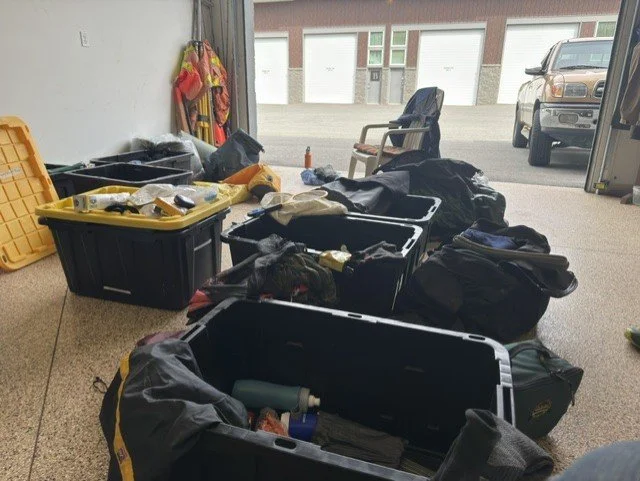
Some things need very little explanation. They have worked, they still work, and you would take them again. Others require a short defense of what you were thinking at the time. Usually, the defense sounds suspiciously like something that once appeared on the packaging.
Then there are the things nobody remembers packing: a branch, a few leaves, bits of the last campsite that apparently decided to come home with us.
We had carried equipment into the woods and, in the interest of fairness, brought some of the woods back.
Among all this were the plastic coffee mugs. Most were the cheap ones you used to get free at gas stations. They had entered our lives as an incidental benefit of buying fuel and somehow worked their way into permanent camp service.
There was nothing technical about them. No impressive construction, no carefully engineered drinking experience. They held coffee. You could wrap your hand around one while somebody got breakfast going, and you weren’t particularly distressed if it acquired another scratch.
They were shabby, useful, and entirely unconcerned with developments in the outdoor industry.
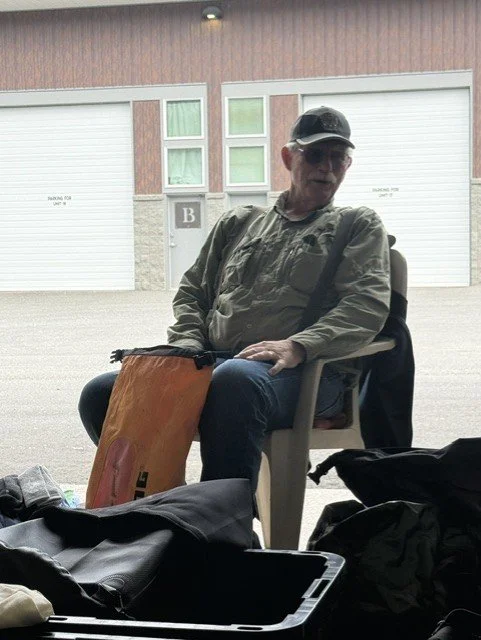
We were drinking coffee in a garage. Standards had been met.
The Mountain House collection deserved its own review.
Over the years, we had tasted and evaluated enough different meals to have opinions. Some were pleasant discoveries. Some were perfectly acceptable when you were hungry. Others had received a fair trial and would not be invited back.
For all that exploration, we still came around to Chili Mac, Spaghetti, Biscuits and Gravy, and a couple of other dependable standards.
We might be adventurous about where we put the camp. Supper did not always need the same degree of uncertainty.
There is comfort in knowing what you are going to get after a day outside. A familiar meal, hot water on the way, a mug within reach. Something that has already proved itself and requires no discussion beyond whose turn it is to get things started.
Which brought us, inevitably, to the water filters.
One particular backup filter—a hand-pump MSR—had earned a place in our collective memory that I doubt its designers intended.
It took forever to pump a gallon of water.
I cannot provide a scientifically defensible account of how long “forever” was. I can tell you that it was long enough for us to settle water duty by roshambo.
Rock, paper, scissors.
The winner got on with the evening. The loser became the water department.
That filter accompanied us on one trip before we found a gravity-fed arrangement. Fill it, hang it, and let the water flow while we attended to something else.
It was a considerable improvement in both camp efficiency and labor relations.
Picking up an old piece of equipment can bring back a fine moment from a journey. It can also bring back a very clear instruction to your future self:
Not buying that one again.
Both are useful.
That is how the stories get started.
Somebody picks something up. Perhaps it is a stove, a mug, or a piece of equipment you haven’t seen since it was put away. You remember buying it. Or you remember the first time it did exactly what you needed, somewhere far enough from a shop that being able to rely on it mattered.
Sometimes the object is an old friend. Sometimes it is more like a familiar landmark on the way home: something ordinary that tells you exactly where you are.
And suddenly you are not entirely in the garage anymore.
There is still traffic outside. You can hear it between voices. But somebody has started telling a story, and the traffic begins to lose its place in the room.
You are back on a riverbank.
You can feel the autumn breeze. You can hear the creek moving past, in no hurry, under no obligation to get anywhere on your schedule. The water keeps going while you sit with a warm mug and listen.
Someone adds a detail. Someone else remembers it differently. A moment you had forgotten comes back because the person across from you happened to keep it.
There is something about sitting in a group with decades of experience between you. Some of it belongs to all of you. Some comes from places the others have never been. A story from one trip brings up another, and the conversation moves along without anybody having to direct it.
You came out to look through the camping gear. Now you are listening to a creek.
The cars are still passing outside.
For a while, you barely notice.
Then there are the coffee pots.
If those coffee pots could talk, we would never finish sorting the garage.
I think the one Dad has is more than forty years old, and it is still cooking. Whatever else has changed in the way we travel, pack, or make camp, it has continued doing the job it was brought along to do.
I would like to hear its version of events.
It has certainly been present for enough conversations. Plans made in the morning, stories told afterward, and all the ordinary talk that fills the spaces between the things we eventually put into photographs.
An inventory would give it one line: coffee pot.
That seems inadequate.
Somewhere in the sorting, we also turned up a still-sealed package of Peet’s coffee from the year before. Apparently, even the provisions had unfinished travel plans.
Dad was passing some of his equipment along to me, too.
There is a particular feeling in receiving something useful from your father. You look it over, consider where it will fit among your own things, and make room for it. All practical matters.
But you also have the opportunity to ask about it while he is standing there.
Where did he use it? What did he like about it? Would he take it again?
Sometimes the answer is brief. Sometimes it leads somewhere that has very little to do with the object itself. Either way, it seems foolish to hurry.
I like the idea of taking those things out again. Looking after them, certainly, but using them. Letting them acquire another trip rather than becoming objects I am reluctant to touch.
An old coffee pot with another morning left in it ought to have that morning.
Dad was there. Charlie was there. We were sorting equipment and talking about where we might go next.
There is quite a lot to be grateful for in that sentence.
Naturally, the conversation reached Africa.
Dad asked about the cost. Charlie took the position that money was no issue.
I admired the spirit of this announcement. It was an excellent contribution to expedition planning, provided somebody eventually attended to the remaining details.
For my part, going the following year meant juggling three trips while still keeping up with work. The possibilities were attractive. The calendar was less cooperative.
This is another familiar feature of a garage gathering. You begin by deciding what to do with an old stove and find yourself considering how much of the following year can reasonably be spent elsewhere.
With the equipment in front of you, the idea becomes easier to entertain. You can see that you already have much of what you need. More importantly, the people you would enjoy going with are standing right there.
There are still costs, commitments, and decisions to work through. We were not resolving every difficulty simply by discussing it over coffee.
But now the trip was in the conversation.
Someone could ask a useful question. Someone could become interested. Someone could point out the difficulty you had conveniently overlooked.
And someone, apparently, could announce that money was no issue.
I suppose we could have made faster work of the garage.
We could have confined ourselves to quantities and condition, kept the conversation relevant, and treated every departure into an old story as an interruption.
I am not convinced that would have been an improvement.
The stories were part of how we sorted things. They explained why an unimpressive item was worth keeping, why another had fallen out of favor, and why certain pieces of equipment still earned an immediate vote of confidence.
They also gave us an excuse to spend time together without needing to invent an occasion.
There is something comfortable about company organized around a modest task. Nobody has to entertain the room. There is something to pick up, examine, or put away when the conversation pauses.
Then somebody remembers something, and off you go again.
Eventually, of course, the equipment has to leave the garage. Otherwise, we have not prepared for an adventure. We have merely rearranged our belongings and given the exercise an ambitious name.
The bags must be packed. The dates have to work. At some point, talking about going must become going.
But I want to give that day its proper place in the story.
When I think about it, I remember Dad and the coffee pots. Charlie and the discussion about Africa. The gas-station mugs, the leaves mixed in with the gear, and the package of coffee that had been waiting since the previous year.
I remember laughing about a water filter that turned a gallon of drinking water into a competitive event.
Mostly, I remember how easily the conversation carried us out of that garage and back to places we had shared—and then onward to places we still hoped to see.
There would be more journeys, more meals to evaluate, and probably another piece of equipment that seemed like an excellent idea at the time.
For now, there was coffee, good company, and the pleasant business of getting ready.
Every adventure begins somewhere.
Ours tend to begin in a garage.
